
If you’ve ever Googled “best JavaScript framework 2026” at 11pm, fueled by caffeine and mild despair, you already know the real answer: there isn’t one. There’s just a pile of tools that are good at different things, and a very loud internet arguing about which pile is morally superior.
Let’s fix that. Below is the honest, no-hype breakdown of React, Vue, Angular, Next.js, Gatsby, Astro, and Svelte — what they actually are, how they compare, and which one won’t have you rage-quitting after your next npm update.
First, a myth to clear up: Gatsby and Next.js aren’t “competitors” of React
This trips up a lot of people early on, so let’s sort it before anything else.
React, Vue, and Angular are the actual UI libraries/frameworks. They’re the tools that render your components to the screen.
Next.js and Gatsby are not peers of React — they’re built on top of it. Gatsby is React plus a build-time GraphQL data layer, a plugin ecosystem, and its own routing and image-optimization system. Next.js is also React underneath, just with a different approach to rendering and routing. Comparing “Gatsby vs React” is a bit like comparing “minivan vs engine” — one contains the other.
So the real comparison actually splits into two separate questions:
- React vs Vue vs Angular vs Svelte — which UI library should you build with?
- Next.js vs Gatsby vs Astro — which way of packaging that library fits your project?
Keep that distinction in your back pocket. It’ll save you from a lot of bad forum advice.
Round 1: React vs Vue vs Angular vs Svelte (the actual UI libraries)
Angular — the heavyweight champ (whether you asked for it or not)
Angular is a full framework, not a library: dependency injection, RxJS, its own CLI and build tooling, all baked in from day one. It’s built for large enterprise apps with big teams, not for a portfolio site or a weekend project. It is, by a clear margin, the heaviest option on this list.
The silver lining: Angular is more disciplined about change than its reputation suggests. Google ships major versions on a strict six-month schedule, with deprecation warnings well in advance and an ng update tool that auto-migrates most of your code for you. Ironically, it might be the most predictable framework to keep current here — just also the least “light.”
React — the stable, popular default
React and Vue are both genuinely lightweight and roughly comparable in size — nowhere near Angular’s footprint. React in particular has been remarkably stable: the Hooks API hasn’t had a breaking change since 2019. Code you wrote for React 18 mostly still works today. If raw stability of the core library is your deciding factor, React wins.
Its downside isn’t the library itself — it’s the ecosystem around it. Client-side data fetching by default, a sprawling universe of optional libraries, and (as we’ll get to) a meta-framework, Next.js, that changes its mind more often than a toddler picking a cereal.
Vue — the friendly middle ground
Vue sits right alongside React on lightness and is generally considered the gentler learning curve of the two. Its one big scar is the Vue 2 → Vue 3 migration (Options API to Composition API), which forced a lot of libraries to be rewritten and caused real pain at the time. It’s been smooth sailing since, though, and Vue remains a solid, comparably light choice.
Svelte — the compiler that skips the gym membership
Svelte plays a different game entirely. Instead of shipping a framework runtime to the browser, it’s a compiler — your components get compiled down to plain, vanilla JS at build time. No runtime overhead, a much smaller dependency footprint, and less to break in your node_modules folder in the first place.
The catch: Svelte 5 introduced “runes” ($state, $derived, etc.), replacing the old implicit let-based reactivity — a genuine paradigm shift, similar in size to Vue’s 2-to-3 break. Old code still runs in compatibility mode, but tutorials and Stack Overflow answers are now split across two mental models depending on which version they’re targeting. It just happened (late 2024), so the ecosystem is still catching up in places. Give it another year and this will be a non-issue.
Verdict, Round 1: For raw lightness, React and Vue are neck-and-neck, with Svelte arguably lighter still once compiled. Angular is the heavyweight, built for a different job entirely — think enterprise dashboards, not personal sites.
Round 2: Next.js vs Gatsby vs Astro (ways of packaging React-family code)
Gatsby — the one that peaked a few years ago
Gatsby’s whole pitch was static-site generation for React, powered by a GraphQL data layer and a huge plugin ecosystem. Great concept. But here’s the plot twist: Gatsby doesn’t ship less JavaScript than plain React — it often ships more. That GraphQL layer and plugin system add real overhead, not less.
That overhead is a big reason Gatsby’s momentum has cooled industry-wide over the past couple of years. Developers building lightweight content sites have largely drifted toward leaner alternatives. Gatsby isn’t dead, but it’s not the “light and fast” pick people once assumed it was.
Next.js — powerful, popular, occasionally allergic to stability
Next.js does build-time (and server-side) rendering well, and it’s the most widely adopted React meta-framework by a wide margin. But it’s also the one with the biggest reputation for update pain on this list. The Pages Router → App Router transition was close to a full paradigm shift, and server components and config conventions have kept shifting release to release. If your gripe is specifically “I upgraded and everything broke,” Next.js is the most likely repeat offender.
Astro — the “actually light” option nobody put on the original list
If the goal is genuinely the lightest possible site, Astro is probably the real answer, and it’s usually missing from these “vs” comparisons entirely. Astro ships zero JavaScript by default — it only hydrates the specific interactive bits you mark, through its “islands” architecture. For a mostly-static personal site or portfolio, that’s about as close to ideal as it gets, versus a full React, Vue, or Angular app shipping its entire runtime regardless of how little interactivity the page actually needs.
Astro also plays nicely with the “stability” problem: your pages compile down to plain HTML with no framework runtime attached, so there’s very little to break when you run an update. The only place you’re exposed to framework churn is inside the specific island component you choose to hydrate (a small React, Vue, or Svelte widget), which you can keep as minimal as you like.
Verdict, Round 2: Gatsby has the least going for it these days — heavier than it looks, and losing ground. Next.js is powerful but the most volatile to maintain. Astro is the lightest and most stable of the three, especially for content-heavy or mostly-static sites.
So which one should you actually use?
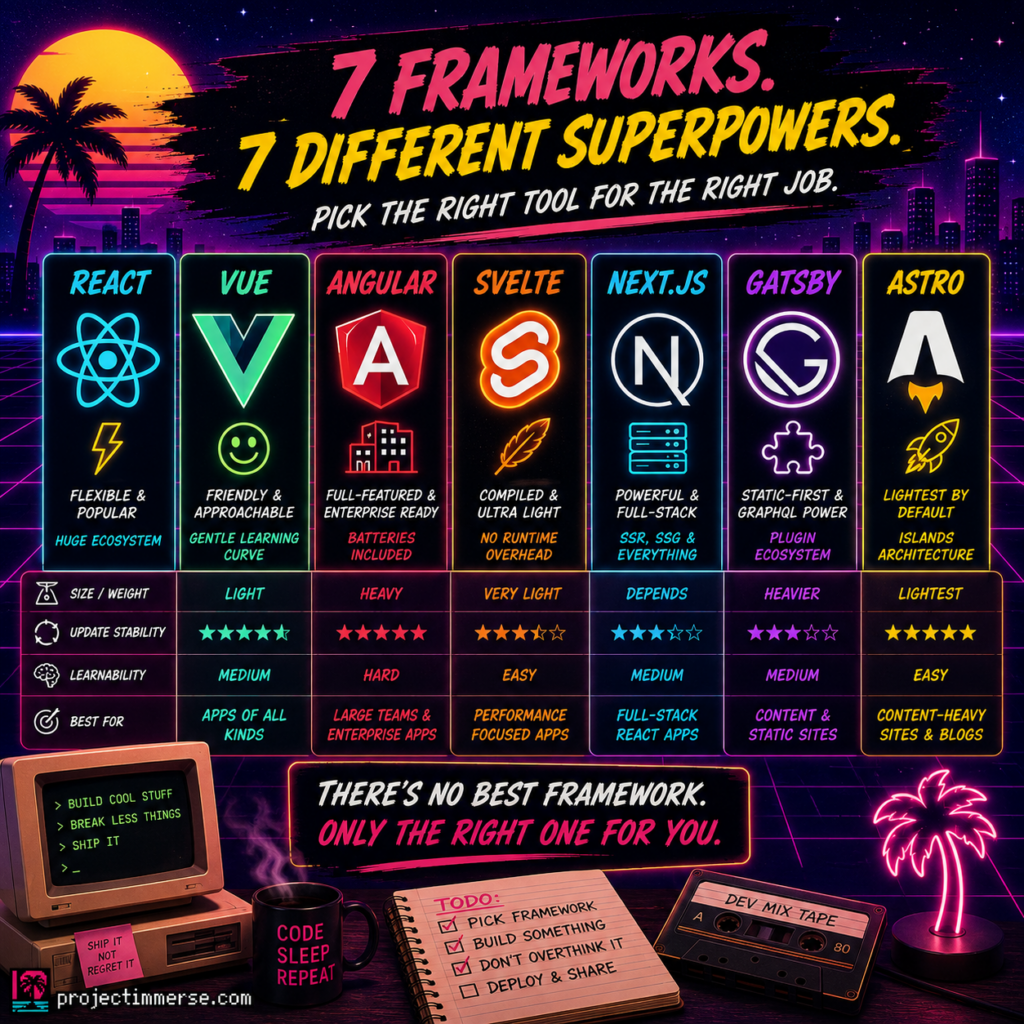
Here’s the cheat sheet:
| Framework | Best for | Lightness | Update stability |
|---|---|---|---|
| Angular | Large enterprise apps, big teams | Heaviest | High (strict release cadence) |
| React | General-purpose apps, huge ecosystem | Light | Very high (core library) |
| Vue | Friendly alternative to React | Light | High (post-v3) |
| Svelte | Small footprint, compiled output | Very light | Medium-high (post-v5 migration) |
| Next.js | Full-featured React apps, SSR | Depends on usage | Lower (frequent paradigm shifts) |
| Gatsby | Legacy static sites (less so now) | Heavier than expected | Medium |
| Astro | Content sites, portfolios, blogs | Lightest overall | High (minimal runtime) |
A quick real-world example: showcasing an API on your portfolio
Say you want to pull in something like your GitHub repos or a skills dataset to show off on your site. The framework choice matters less here than when you fetch the data:
- Build-time fetching (fetch once when the site builds, bake the result into static HTML) keeps your site fast and JS-light. Astro supports this natively — you can fetch data right inside the component with no extra library. Next.js does this well too, though you’re pulling in the full React runtime for the rest of the page even if only one section needs it.
- Client-side fetching (fetch live, every time someone visits) is only worth the extra JS if the data genuinely changes in real time — like a “currently listening on Spotify” widget. Plain React or Vue apps default to this, which can mean your content flashes empty before populating, which isn’t a great first impression on a portfolio.
The sweet spot for most personal sites: build the whole thing in something light (Astro, or a lean Svelte setup), and only drop in a small interactive “island” for the one piece of data that truly needs to be live.
The bottom line
There’s no single “best” framework — there’s a best framework for what you’re building. Angular for big enterprise software, React or Vue if you want a proven, lightweight, well-supported default, Svelte if you want compiled-away overhead, and for a portfolio or content site specifically — the thing that will make Google’s Core Web Vitals actually smile at you — Astro is very hard to beat.
And if all this framework-hopping still gives you flashbacks to a broken node_modules folder at 2am: you’re not wrong to be cautious. Just maybe let this be the last “which framework” post you have to read before you ship something.