Why Some React & Next.js Projects Use “@” in Imports (And Some Don’t)

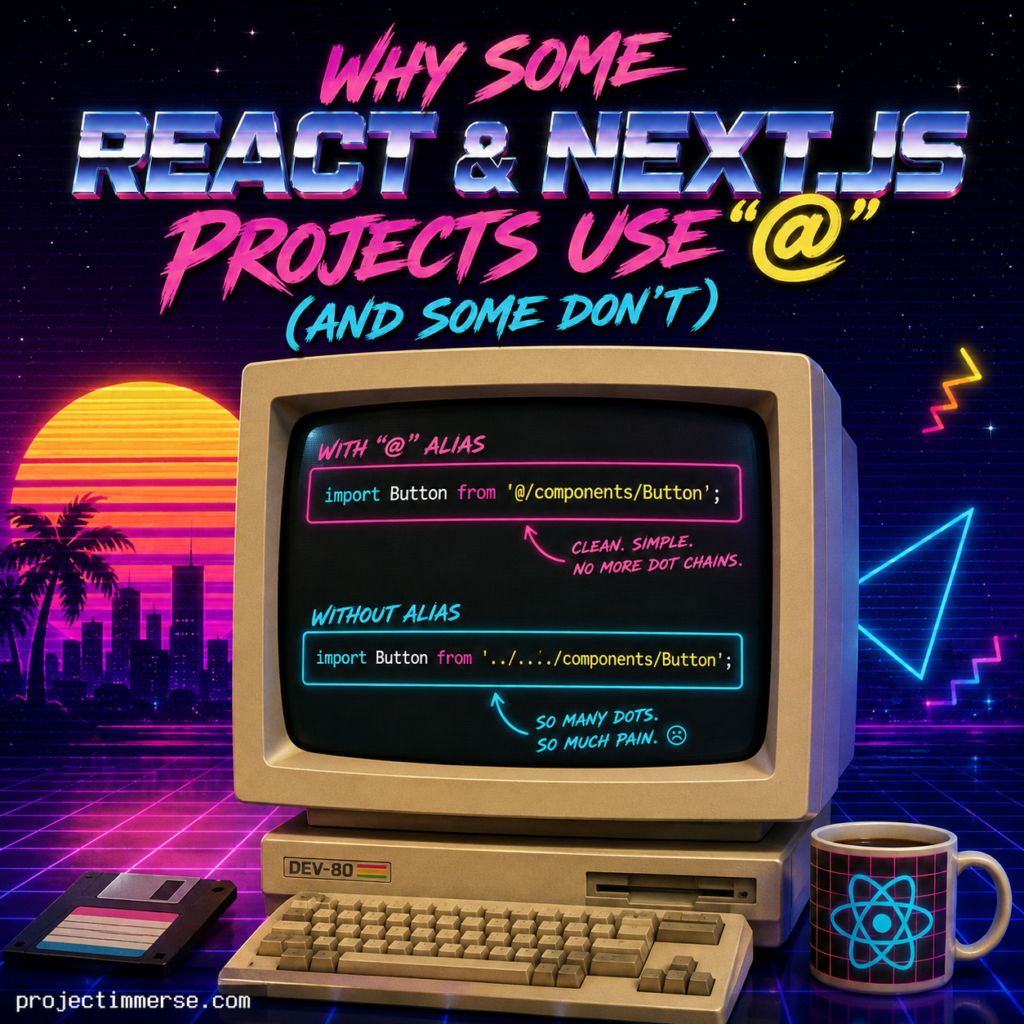
Illustration showing a React and Next.js path alias (@/) compared with traditional relative imports on a vintage CRT computer screen.
Visual comparing React and Next.js @ path aliases with traditional relative imports, illustrating why many developers prefer cleaner import paths.

If you’ve spent any time jumping between React or Next.js codebases, you’ve probably noticed something weird: some projects have imports like this —

js

import Button from '@/components/Button';

— and others look like this:

js

import Button from '../../../components/Button';

Same framework. Same language. Wildly different vibes. So what gives? Is the @ some secret JavaScript operator nobody told you about? A cry for help from a developer three folders too deep?

Not quite. Let’s clear it up.

Continue reading “Why Some React & Next.js Projects Use “@” in Imports (And Some Don’t)”

dependencies vs. devDependencies in package.json: The Difference (And How to Stop Mixing Them Up)

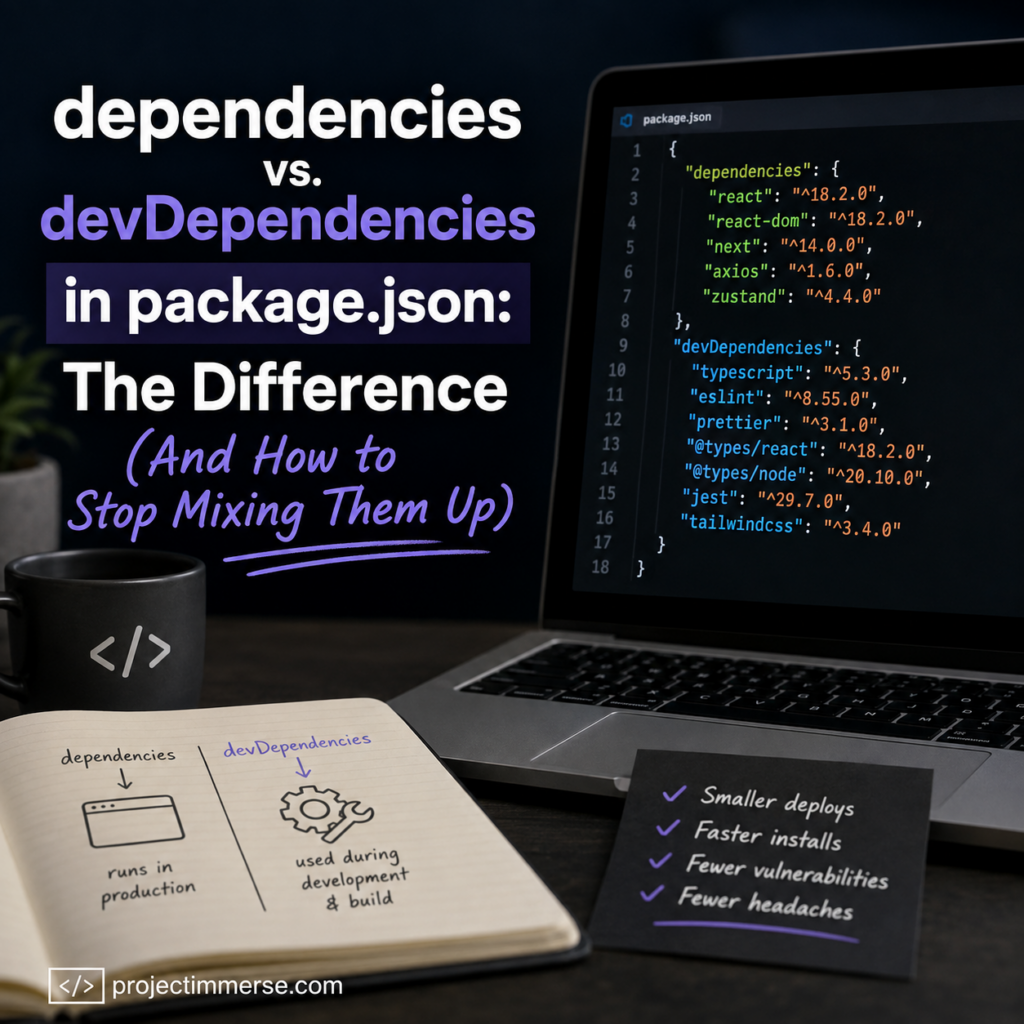
Laptop displaying a package.json file illustrating the difference between dependencies and devDependencies in a Node.js project.
Understanding when packages belong in dependencies versus devDependencies is one of the easiest ways to avoid frustrating deployment issues.

If you’ve ever run npm install on a fresh clone of a React or Next.js project and thought, “cool, I have literally no idea why half of these packages are in devDependencies and the other half aren’t” — congratulations, you’re a normal developer. This is one of those things that seems obvious until you actually have to explain it, at which point your brain quietly leaves the room.

Let’s fix that. By the end of this article, you’ll know exactly where a package belongs, why it matters more than you think, and how to stop guessing (or worse, copy-pasting from Stack Overflow and hoping for the best).

Continue reading “dependencies vs. devDependencies in package.json: The Difference (And How to Stop Mixing Them Up)”

What is Vibe Coding? The New Way Developers Are Writing Code

Developer in flow state practicing vibe coding with laptop, headphones, and creative code energy
Vibe coding blends creativity, focus, and fun to make programming more enjoyable.

Coding used to be all about structure, rules, and precision. But in 2025, a new approach is reshaping the way developers work: vibe coding. Instead of forcing yourself into rigid patterns, vibe coding is about writing code in a state of flow — where productivity meets creativity and you actually enjoy the process.

Continue reading “What is Vibe Coding? The New Way Developers Are Writing Code”

Git using GitFlow

Git using GitFlow Guidelines

I was recently introduced to a Git methodology called Git Flow. Git Flow itself is more of a guideline that they are rules. Vincent Driessen coined the term, however much like myself, developers were probably already implementing this approach long before it gained popularity, or some variant of it. I do remember working on a small team in a past life, long ago when I was a young and chipper programmer. I do remember collaborating with my dev team and using a flavor of GitFlow. Looking back, I now see it’s power in both and even really large development teams. I must admit though, s’been a long time since I’ve worked on a team, so this will be an interesting run for me. Continue reading “Git using GitFlow”

SCP – Secure Copy

SCP – Secure Copy Command (Unix)

We all know about FTP (file transfer protocol), FileZilla, Cyberduck and friends – utility tools that allow developers to transfer files between clients and servers. I’ve used FTP over a million times in my development career. From backing up files, migrations, or new fresh installations of some framework or CMS system – like WordPress.

Well there will be some situations where you you might need the help of Unix’s scp – or secure copy. This is a command you have to run so those of you that’s never fired up the terminal will need to get your hands dirty with it. Play around and run some commands and make some mistakes – well in a sandboxed environment, don’t want to totally delete your entire life’ work.

Continue reading “SCP – Secure Copy”