Ruby Built-in Data Types

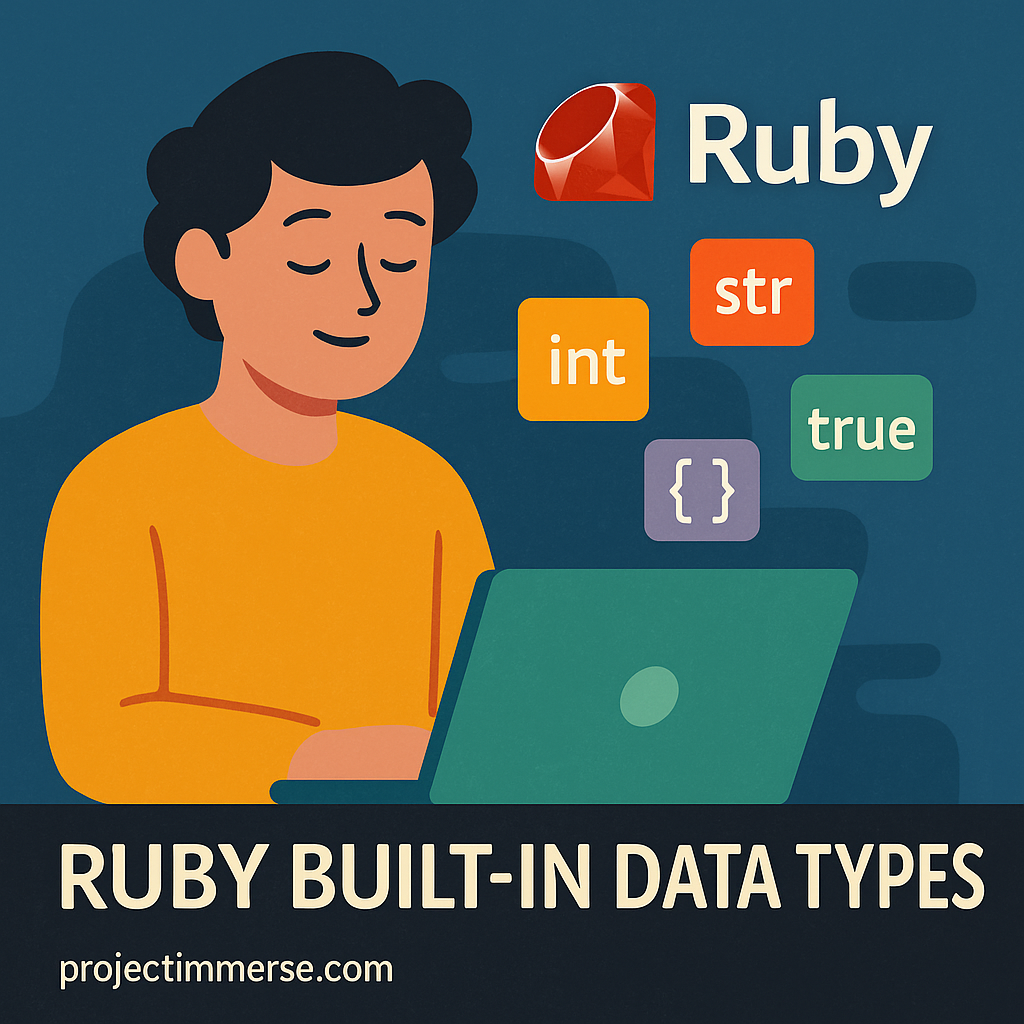
Flat illustration of a developer coding in Ruby with floating data type labels and Ruby logo on a blue background.
Discover Ruby’s built-in data types including numbers, strings, arrays, hashes, and symbols with clear examples.

When learning Ruby, understanding its built-in data types is one of the most important steps. Data types define the kind of values you’re working with and how Ruby interprets and manipulates them.

Ruby keeps things simple but powerful — everything is an object, and each data type comes with its own methods and behaviors.

Let’s walk through Ruby’s essential data types with examples you can try right away.

Continue reading “Ruby Built-in Data Types”

Linear Linked List – Search Element using Python

Linear Linked List using Python

What’s up friends?!?

Let’s continue on another linear linked list problem. I’m going to make this post short since I’ll use the boilerplate code from the last LLL problem we had. If you need any help, I’ll also post the link to GitHub so you can stroll along.

Anyways, for this problem, I just want to write some code to find a specific element inside the LLL. You could do this iteratively or recursively, whichever way you choose to do, but for the purpose of this program, I am just going to solve it iteratively.

Continue reading “Linear Linked List – Search Element using Python”

Linear Linked List – Insert Element Beginning using Python

Linear Linked List - Insert Element at Beginning using Python

What’s up friends?! Hope your week has been great as always, the weather here has been quite chilly and then hot at different days, so I’ve been taking advantage of it and go hiking quite a bit to clear up my head.

Today, I want to take a moment to introduce data structures. Data structures is one of my favorite topics ever, and in my personal opinion, possibly one of the most important courses of computer science in general, as it provides the foundation for later on. Well, WHAT IS DATA STRUCTURE? Data structure essentially is a way of organizing data for the machine to work efficiently, and you have seen it before, such as array! As such, I want to talk about linear linked list because I am positive colleges would definitely throw these at you, and you definitely are going to spend hours and hours on data structures!
Continue reading “Linear Linked List – Insert Element Beginning using Python”

Bubble Sort Algorithm using Python

Bubble Sort Algorithm Using Python

Hey!!! What’s up everyone?! I hope your week has been great! I have been working on tirelessly on my projects, so I am going to take a short break, and write up this article!

For today, I want to touch base on a classic algorithm that students have seen over the years, and it is called Bubble Sort Algorithm! Now, before I get started, there are obviously much better sorting algorithms are there, but for the sake of improving our critical thinking skills, Bubble Sort Algorithm is a good one!

Continue reading “Bubble Sort Algorithm using Python”

Permutations Using Python

How’s it going everyone?!?

I hope your week has been great and staying healthy. Today I am going to talk about permutations using Python. The version that I am going to use for this program is Python 3.8.3.

Well, what are permutations????? Permutations in mathematics basically are just different combinations of a sequence, and that is exactly what we are going to do. We are going generate a random sequence of integers and find different combos for this sequence!

Continue reading “Permutations Using Python”

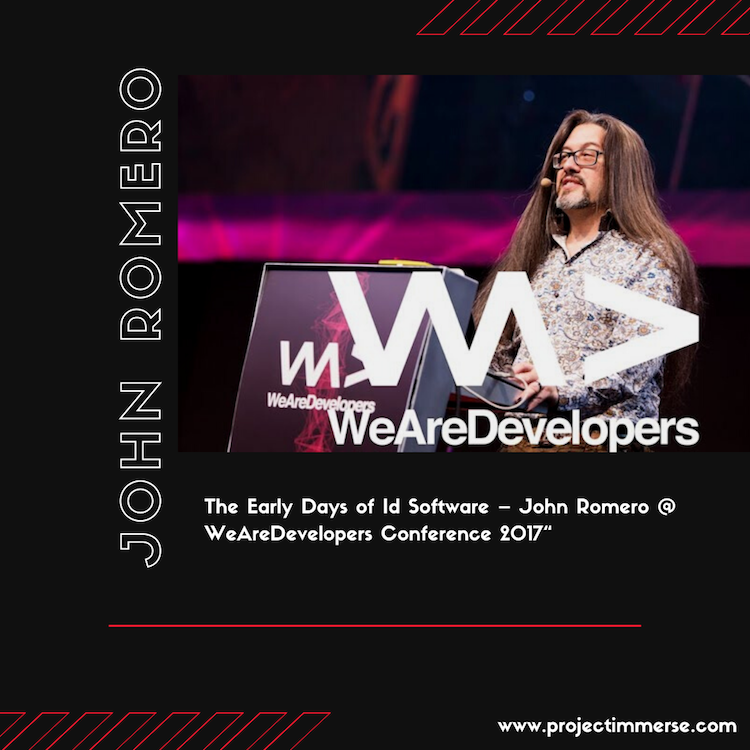
The Early Days of Id Software – John Romero

The Early Days of Id Software - WeAreDevelopers Conference by John Romero

I decided to take a break from my usual programming and wandered the internet, I tried breaking away from any programming related videos. I was looking for something light, I don’t know maybe a web dev conference.

This post is based off a youtube video I stumbled on, it’s entitled “The Early Days of Id Software – John Romero @ WeAreDevelopers Conference 2017“. You know, I didn’t know who John Romero was and I played both DOOM and QUAKE back in the early 90s. John was rockin’ the long hair, it was super long, looked super cool though. I wish they would invite more people like John over to Web Dev Conferences.

Continue reading “The Early Days of Id Software – John Romero”

Generating SSH Keys on MacOSX

Generating SSH Keys on MacOSX

If you’ve been programming for a while now, even if you consider yourself a novice, you’ve probably run into the SSH (Secure Shell) protocol. Now, don’t get intimidated by this technical term, this is just another protocol like FTP (File Transfer Protocol) or HTTP (Hypertext Transfer Protocol). So look, you’ve already engaged with a protocol at one point in your dev career. In simple terms, protocol’s are just a set of instructions to complete a given task.

Continue reading “Generating SSH Keys on MacOSX”

substr() vs preg_match() using PHP

substr vs preg_match

Greetings fellow developers, I hope you’ve continued to immerse yourself in something interesting whether it’s programming, physics, math – or whatever. The point is – just keep pushing forward and don’t be afraid to fail. Seriously though, enjoy the journey of making mistakes.

This post is about two functions – PHP’s substr() and preg_match() functions.

Continue reading “substr() vs preg_match() using PHP”

Distributed Systems in One Lesson

Distributed Systems in One Lesson

Alright, this is a continuation of System Architecture, a super broad subject I’ve been recently immersing myself in. I must admit, my last post was a bit poor in quality – I even left things hanging in the end. So I felt compelled to dive in deeper into an architecture known as “Distributed Systems”, yes in one lesson by Tim Berglund.. As the name of this blog post suggests, this is based off a youtube video I found – Distributed Systems in One Lesson.

Continue reading “Distributed Systems in One Lesson”

Architecture vs Design Pattern

Architecture vs Design Pattern - System Architecture

I’ve decided to take a break from some lower level stuff – server side languages, scripts and front end stuff. As in “break” – I meant in my blog posts. My thirst for more Javascript and PHP is unending so that is still quite active.

I’ve developed a sudden interest in system architecture – I think this was ignited off a job requirement I’ve recently run across. Almost everything listed as a requirement I had covered and even the ones I wasn’t quite savvy with I knew I could pick up pretty fast – ie frameworks and libraries. When I look at job requirements, I look at the underlying fundamentals or lack thereof with regards to my toolbelt.

Continue reading “Architecture vs Design Pattern”