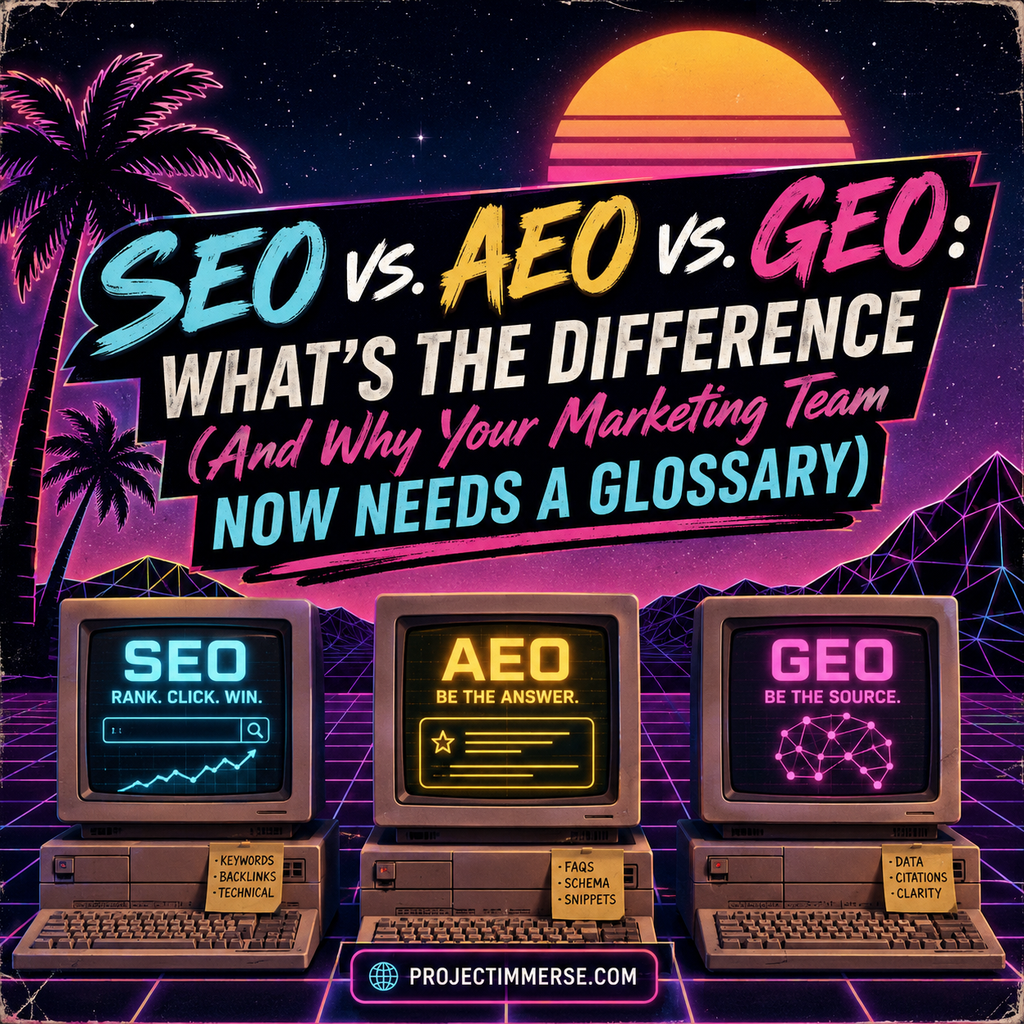
If you’ve spent any time in a marketing meeting over the past year, you’ve probably heard someone drop “GEO” into a sentence and watched half the room nod like they knew exactly what that meant. They didn’t. Nobody does — not fully, anyway. The truth is, the industry is still arguing about the definitions in real time, which is a very reassuring thing to build a strategy around.
But here’s what we do know: the way people find information is splitting into three lanes — search engines, answer engines, and generative AI — and each one plays by slightly different rules. Let’s break them down.
SEO: The One Everyone Already Knows
Search Engine Optimization is the OG. It’s been around since roughly the dawn of “let me Google that.” SEO is about getting your website to rank well on traditional search engines like Google and Bing so that when someone searches a relevant term, your page shows up — ideally near the top, and ideally before your competitor’s page.
The classic SEO toolkit includes:
- Keywords — using the words and phrases people are actually searching for
- Backlinks — other reputable sites vouching for you by linking to you
- Technical performance — site speed, mobile-friendliness, clean site architecture
- Metadata — title tags, meta descriptions, alt text (the unglamorous stuff that quietly does a lot of work)
The end result of good SEO is simple: a list of blue links that a human scans, judges in about half a second, and clicks (or doesn’t). It’s the discipline of earning attention in a results page.
AEO: When Search Started Just… Telling People the Answer
Somewhere along the way, search engines got tired of making people click through to find things out. Enter Answer Engine Optimization.
AEO is about optimizing content to be pulled directly into a “direct answer” format — think Google’s featured snippets, the “People Also Ask” boxes, or what Alexa or Siri reads back to you when you ask a question out loud. Instead of winning the click, AEO wins the answer slot.
This requires a different kind of writing than classic SEO. You need:
- Clear, concise answers to specific questions (ideally right near the top of the content)
- Structured formatting — think FAQ sections, numbered steps, and short definitional paragraphs
- Schema markup, so search engines can easily identify “this is the answer to that question”
Basically, if SEO is about getting invited to the party, AEO is about being the first thing said when someone asks “so what’s the deal with this?”
GEO: Optimizing for AI That Doesn’t Even Show You the Link
Now for the new kid: Generative Engine Optimization. This is genuinely unfamiliar territory for a lot of marketers, because GEO doesn’t compete for a ranking position or a snippet box — it competes to be cited, paraphrased, or recommended inside an AI-generated answer from tools like ChatGPT, Google AI Overviews, Gemini, Perplexity, or Claude.
Here’s the uncomfortable part for traditionalists: the user might never visit your site at all. The AI reads it, digests it, and hands the reader a synthesized answer with (maybe) a citation. Your entire job becomes convincing a language model that your content is the trustworthy, well-structured source worth pulling from — no click required.
GEO tactics lean heavily on:
- Statistically rich, well-sourced content (data > vibes)
- Clear citations and authoritative structure
- Semantic clarity — writing that’s easy for a model to parse and summarize accurately
- Genuinely comprehensive coverage of a topic, not thin, keyword-stuffed pages
If AEO is “be the answer in the box,” GEO is “be the source the robot trusts enough to quote.” A subtle but important difference — and one that’s changing fast enough that best practices from six months ago are already a little dusty.
Why This Is Suddenly Everyone’s Problem
This isn’t just theoretical hand-wringing. AI-powered search is eating a real, measurable slice of how people find things:
- Nearly a third of the U.S. population is projected to use generative AI search in 2026.
- Google AI Overviews now reach well over two billion monthly users, and their share of Google searches roughly tripled during 2025.
- ChatGPT alone processes on the order of two billion queries a day.
Translation: a meaningful chunk of your potential customers are no longer scrolling a results page at all. They’re asking a chatbot, getting a confident-sounding paragraph back, and moving on with their day — sometimes without a single click landing anywhere near your website. If your content isn’t structured in a way an AI model can parse, trust, and quote, you’re invisible to that entire segment, no matter how well you rank in classic search.
What Each One Looks Like in Practice
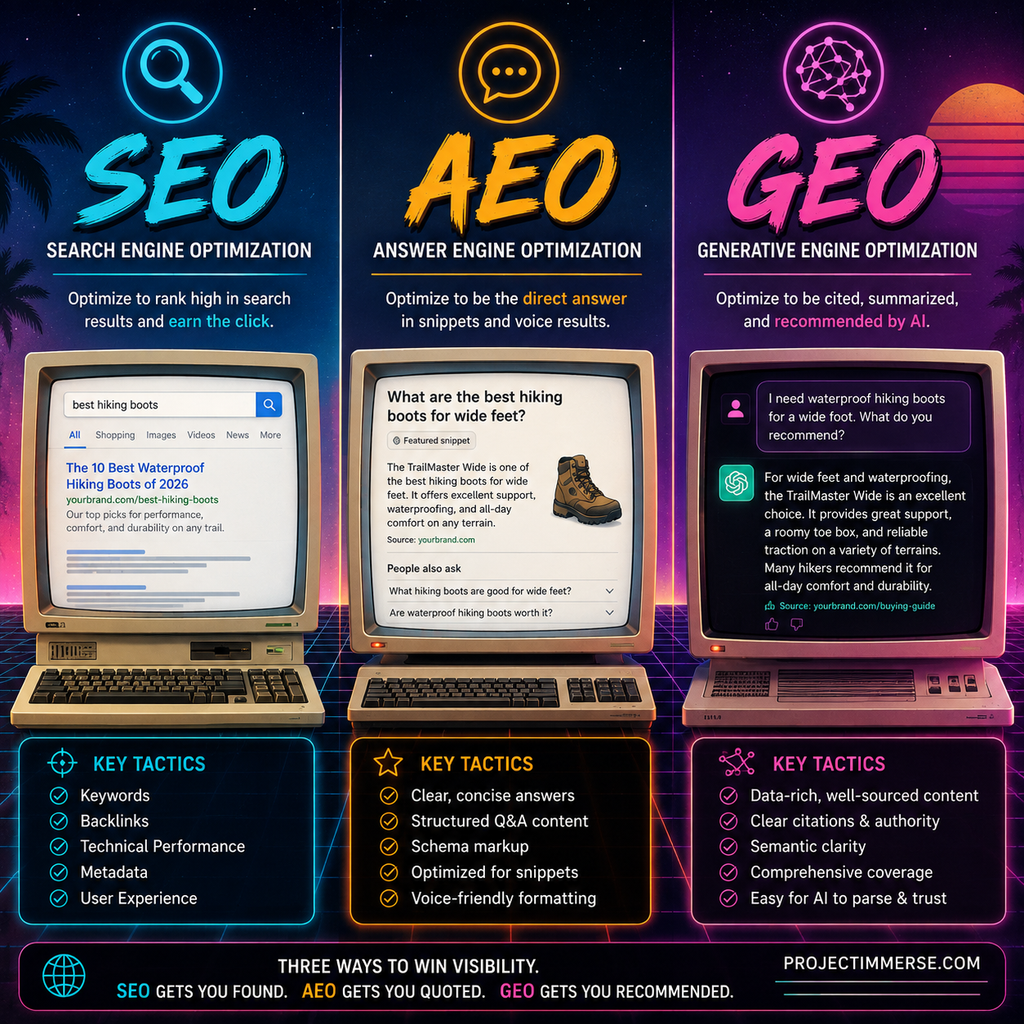
Abstract definitions are nice, but let’s ground this in an example. Say you sell hiking boots.
SEO wins when someone searches “best waterproof hiking boots” and your product page ranks on page one — thanks to solid keyword targeting, a fast site, and other outdoor sites linking to you.
AEO wins when someone asks their phone “what’s the best waterproof hiking boot for wide feet,” and your FAQ page’s clearly formatted answer gets pulled into the featured snippet or read aloud by a voice assistant, without the person ever opening your site.
GEO wins when someone asks ChatGPT “I need waterproof hiking boots for a wide foot, what should I get,” and the model — having absorbed your detailed, well-sourced buying guide somewhere in its training or retrieval process — recommends your brand by name, maybe with a link, maybe without one at all.
Same customer, same intent, three completely different battlegrounds.
Is There More? (Yes. Of Course There Is.)
Because the internet cannot resist a good acronym pileup, you’ll also run into:
- LLMO (Large Language Model Optimization)
- AIO (Artificial Intelligence Optimization)
- “AI SEO” (basically just SEO with a nervous energy)
Here’s the honest truth: as of 2026, there’s no agreed-upon, industry-wide definition separating these terms. They’re used interchangeably by different vendors, agencies, and blog posts (including, arguably, some of the ones we researched to write this). Treat GEO as the practical umbrella term for “optimizing for AI-generated answers,” and treat AEO/LLMO/AIO as slightly different flavors of the same idea, depending on who’s selling you a subscription.
SEO vs. AEO vs. GEO: The Side-by-Side
| SEO | AEO | GEO (+ LLMO/AIO) | |
|---|---|---|---|
| Target | Search results pages | Direct-answer boxes, voice assistants | AI chat & generative responses |
| Platforms | Google, Bing | Featured snippets, Siri, Alexa | ChatGPT, Gemini, Perplexity, Copilot, AI Overviews |
| Goal | Rank high, earn the click | Be the extracted, direct answer | Get cited, paraphrased, or recommended |
| What the user sees | A list of links | One pulled-out answer | A synthesized, conversational response |
| Key tactics | Keywords, backlinks, site speed | Structured Q&A, schema markup, concise answers | Data-rich content, citations, semantic clarity, real depth |
| How mature is it? | Decades old, well understood | Established, several years in | Brand new, no agreed measurement standard yet |
So… Which One Should You Actually Do?
All of them. Sorry. There’s no clever shortcut here — the good news is they’re not mutually exclusive, and a lot of the underlying work overlaps. Clear structure, genuinely useful content, and credible sourcing help you across all three. Nobody, human or robot, is out here rewarding vague, padded, keyword-stuffed nonsense — they’re just checking for it in different formats now.
A practical way to think about it:
- SEO gets you found.
- AEO gets you quoted directly on the search page.
- GEO gets you quoted inside the AI’s actual answer, even when there’s no search page involved at all.
Ignore any one of the three and you’re leaving a growing chunk of your audience’s discovery journey to chance — and with AI-powered search adoption climbing fast, that chunk isn’t staying small.
Frequently Asked Questions
Is GEO just a rebrand of SEO?
Not quite. SEO is about ranking on a results page; GEO is about being trusted enough by an AI model to get quoted or recommended, often with no results page in sight at all. They share DNA (good content, credible sourcing) but they’re optimizing for different “judges” — a search algorithm versus a language model.
Do I need to pick one?
No, and honestly you can’t. A well-structured, genuinely useful page tends to perform reasonably well across all three, because the underlying qualities — clarity, credibility, comprehensiveness — matter to search engines, answer engines, and AI models alike. Think of it as one strong foundation with three different roofs.
Which one should I prioritize first if I’m just starting out?
SEO, still. It’s the most mature discipline with the clearest playbook and the most reliable tools for measuring success. Layer AEO and GEO tactics — structured Q&A sections, schema markup, clear citations, data-backed claims — on top once the SEO foundation is solid.
How do I even measure GEO success?
Carefully, and with a grain of salt. The tooling here is genuinely immature — there’s no universal standard yet for tracking “AI citations” the way there is for search rankings. Some vendors offer AI-visibility tracking tools, but treat early metrics as directional, not gospel.
The Bottom Line
SEO, AEO, and GEO are less like competing strategies and more like three checkpoints on the same road — Google’s blue links, the direct-answer box, and now the AI chat window. The tools and terminology will keep shifting (probably before this post is even a year old), but the core principle hasn’t changed since the very first SEO blog post was written: be clear, be credible, and actually answer the question people are asking. The acronyms are just catching up.

Related Posts
 Setting Up a New Laravel App: A Real Walkthrough (Including the Part That Broke)
 MySQL Workbench Alternatives: The Best Database Tools for Local, Dev, and Production
 Getting Started with Vue 3: From npm create vue to Understanding script setup
 Next.js Confused Me on Purpose: A Field Guide to Framework Gotchas