Data Structures & Algorithms II

Data Structures & Algorithms II

This is part || of Data Structures & Algorithms using Javascript. I would like to give credit to freeCodeCamp.org for their series of videos covering this topic.

In part I we started off with a simply defining a few data types – an array and a string for storing data in memory. Then we used a “for-loop” to access and manipulate our data structures. Finally we came up with a sequence of steps to test whether a word was a palindrome or not. In part II now, were going to wrap up all that code into what we call a function object.

Functions are a powerful data structure encapsulating your algorithms. Functions also are a good example of “DRY” – Don’t Repeat Yourself.
Continue reading “Data Structures & Algorithms II”

Data Structures and Algorithms in Javascript – Stacks

Data Structures and Algorithms 1 - Stacks

Javascript is a language most developers either overestimate or underestimate – whatever the case, this is what makes Javascript special. Javascript is a dynamic language, it’s abstract and for this reason also prone to instability. Javascript in the last decade has provided developers with a place for inventiveness and innovation.

Lately I’ve been immersing myself into mathematics, physics, chemistry, philosophy and even linguistics. I found my premise to still hold true – that the universe is at a state of decay, of disorder, and mutation. It’s exactly because of mutation that we are able to manage disorder and chaos, so in a sense we are constantly trying to keep up with ourselves as we simultaneously and inevitably push forward into the future.

Continue reading “Data Structures and Algorithms in Javascript – Stacks”

UNIX: Making Computers Easier To Use

UNIX: Making Computers Easier To Use

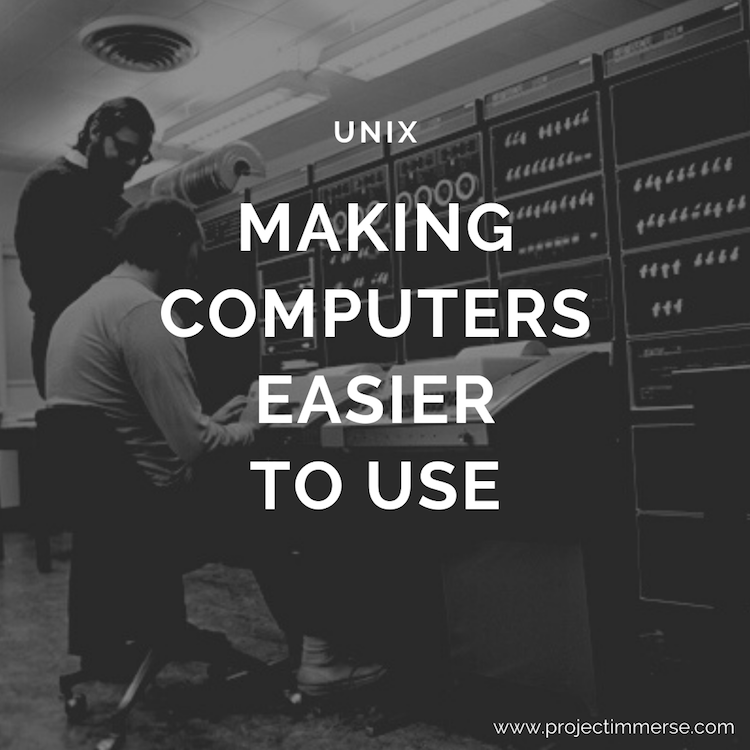
This post is a video review based on UNIX: Making Computers Easier To Use — AT&T Archives film from 1982, Bell Laboratories. Just like its titled thats how Unix came to life. Without its creators – Dennis Ritchie and colleague Ken Thompson, computers would not be better off with the Unix operating system. I was continuing the endless journey with programming in C but I stumbled upon one of those classics.

You would think these two brainiacs would be in some garage coding dungeon but nope, Unix was born at Bell Labs. I could just imagine both of them staying in late and hacking on some code. Well, that’s exactly what they did and now we have iOS, MacOS, Linux and Android – which all power a lot of devices we have today.

Continue reading “UNIX: Making Computers Easier To Use”

C Programming Part 1

C Programming - Part 1

I’ve been wanting to write a post about the basics of C programming language so here I am. We’ve heard it before from several or our nerdy colleagues – “Oh, I took a C programming class back in college, but I forgot all about it”. Well that’s because you obviously haven’t built many applications using C. To really know something in programming is to actually have done it.

I myself fall guilty of this – except I managed to salvage a C book at some random book donation. It was a super thick book, you just can’t imagine a C programming book being any other way. Its hardcover was in pastel yellow, inside was a pretty rough read. To be honest I only made it half way through the book, this was back in the mid 90s.

Continue reading “C Programming Part 1”

Smooth Scroll with jQuery

Smooth Scroll with jQuery

Every now and then I get some really cool feature request, nothing too big – just something simple yet effective. Anchor links aren’t talked about much these days but they’re so useful in situations where you run into a really long website with a lot of content (or anything), you have to keep scrolling down just to get to the footer. Worse yet, what if the contact form is down at the footer – that’s a lot of wasted time, space and potential customers lost. Not a good thing.

The solution and probably the most simple and effective way is to add an anchor link. This can easily be done with plain HTML.

Continue reading “Smooth Scroll with jQuery”

Javascript Debugger Statement

Javascript Debugger Statement

I was working on a behemoth, yeah look it up – the word means monstrous and enormous in size. This project was more on the marketing side, so there were a lot of platforms mixing in with this project, one of them being Hubspot – a marketing software for managing leads. I’ve never worked with HubSpot before, but I was totally game.

In troubleshooting the underlying issue(s), I like to categorize projects like hurricanes – cat1, cat2, cat3, cat4, cat5. This one was a cat4. Partly because it’s history was so vague, the type of project where you’re shooting darts in the dark. But the other half was much simpler – I just had to get familiarized with Hubspot, but this is an entirely different topic. I went off tangent here for a bit. Moving on.

Continue reading “Javascript Debugger Statement”

Youtube Auto Loop a Video

Looping a Youtube Video

I was working on adding a few features to a pet project – one of them was allowing users to add a youtube video to their profile page. In order to this though, we need to get familiarized with youtube and a few parameters we already know.

A commonly known parameter is autoplay, if we set this to “1” – the youtube video will play automatically on an initial page load.

The general structure is illustrated below, get familiar if you aren’t already – this is a pretty cool feature.

Continue reading “Youtube Auto Loop a Video”

Javascript Fundamentals

Javascript Fundamentals

Whoa that title, yeah it made me cringe a little don’t ask me why. Perhaps it’s because I’ve seen it over countless times but I couldn’t think of a better title. I was gonna go with “Vanilla Javascript” but we all know that deserves it’s own space.

Javascript fundamentals is like going back in time, sort of like when the earth was formed. Were not going to get into the details of lexical environments or function scope or objects, well maybe a little on objects. Were going to just simply define a few javascript constructs.

Continue reading “Javascript Fundamentals”

PHP’s is_numeric function

PHP is_numeric function

I’ve been wanting to write about PHP’s is_numeric() built-in function partly because I forgot all about it one day while validating one of my forms.

I get super anal about form validation because if it’s anything that’ll make or break your web application it’s security. Something dirty gets through your form it’s game over – or just bad data, bad quality. This means bad user experience – see how this kind of thing can trickle down through your application you worked so hard on?

Continue reading “PHP’s is_numeric function”